If You Ask Nicely
Look, I have not thought about Highguard. I did not watch The Game Awards, and I have only seen the social media murmurings of people professionally too-in-the-know about this game's conspicuous lack of marketing. Don't tell me anymore! I don't want to know!
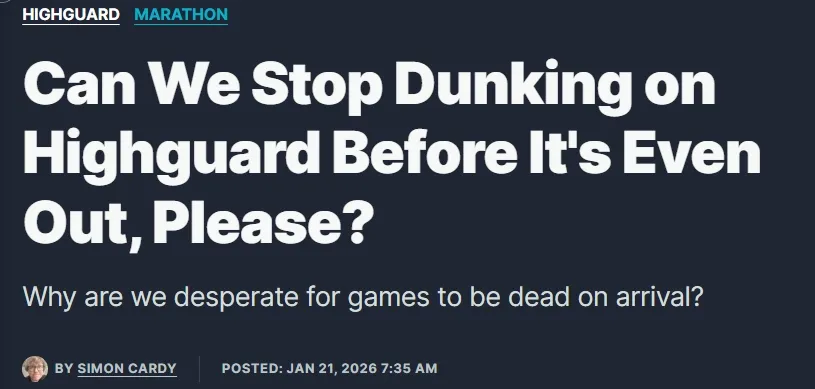
It's harder to avoid IGN. I go back and forth on whether it's better to largely ignore IGN or to hold them to the high standard that their size and influence demands. (I usually just follow the writers I enjoy reading wherever they go.) Dissent is largely unwelcome in the mainstream press, so I mostly keep it to myself, but it is harder still to ignore this article, which does not call itself an op-ed and is written by a Senior Editor. Simon Cardy's Can We Stop Dunking on Highguard Before It's Even Out, Please?, published on January 21, 2026, epitomizes much of what I take issue with in the enthusiast press, and it reasonably stands for what the outlet believes in. I think that's worth interrogating. And I also think some dissent is called for when the largest platform in my industry publishes an incredulous defense of the status quo while promoting anti-intellectualism that has proven an existential threat to my own work.
And so I’m here to state what I thought would be obvious: we should actually play games before we definitively decide if they’re good or bad.
The foundation of this article is made of straw. Who is we? IGN? Games media as a whole? Am I party to this instruction? Simon opens on the exigent image of a YouTube search, surfacing what he later admits are headlines “engineered with social media and ragebait content algorithms in mind,” which is a we that I don’t see myself or my readers as a part of. Should I care what these nameless channels, reactionaries, and AdSense chasers think? Do YouTube thumbnails and titles alone constitute the critical consensus he speaks of? Simon provides no citations, and the headlines he does offer are not presented as actual examples taken from any channel.
It's this immediate and complete writing off of a game that irks me somewhat.
I checked Metacritic just to make sure this game wasn't somehow scored pre-release. I don't know of any reviews of the game yet. Even Simon’s made up examples from the top of the article (“This Game is Cooked”, “It’s Worse Than We Thought!”, and “What Happened?”) are couched in marketing, development, and sales. So, it hardly seems like Highguard has a “predetermined fate” or that opinions on the game itself have been decided. If the marketing is not convincing people, it's not convincing them. There is no expectation — professional or enthusiast — to be courteous about our reaction to marketing materials.
I realise I’m largely swimming against a tide...
I would simply walk along the shore rather than ponder the riptide of YouTube from under the waves, but not all writers get to choose our battles.
We all know that, on the internet in 2026, it’s much easier to tear something down than reinforce it with optimism.
From here Simon betrays a sense of obligation to reinforce negative discourse with optimism as if that is the function of games media. While he doesn’t cite anyone, Simon conjures the image of “people gleefully rubbing their hands together” watching the game fail, presumably as a consequence of this discourse. It’s a naive assumption to believe the people making clickbait thumbnails are sincere, and it is even more naive to believe that anyone in games media can construct a discourse powerful enough to influence which games are made or which devs get to keep their jobs. But whether Simon really believes in this power or not, the goal of the rhetoric remains the same: Stop speaking so negatively about these products.
I’m by no means convinced that either of these games will be blockbuster hits, nor guarantee that they’ll be amazing shooters in their own right, but I at least want to give them a chance.
Simon further hampers his argument by invoking Marathon, a game we should all be skeptical of. Instead, Simon insists that his excitement for the game in the face of both mass and high-profile lay-offs at Bungie and the developers history of under-delivering is some transcendent position superior to the cacophonous rhetoric of dissenters, as if wanting to give the game a chance is a virtue. This tries to come off as above it all, but it just looks like IGN defending Sony from YouTubers and skepticism.
Because if we’re not getting excited about games, what are we even doing here?
This article was never about playing games before definitively deciding if they are good or bad. The only legitimate definitive position under this worldview is a positive opinion. Here, we’re getting excited about games. All of them. Because Geoff Keighley told us he thinks it's good. Because it's from a Call of Duty dev. Because the marketing said they're making a "new breed of shooter" and we really believe them. Upholding feelings—especially feelings as pretextual as fun and excitement—is not the work of a critic. Nor is upholding particular feelings IGN's work as a publisher of reporting and criticism. “If we’re not getting excited about games, what are we even doing here?” is not an argument. It is pure ideology.
Maybe in 2026, it should be updated to “Never judge a game by its initial teaser and lack of marketing beats running up to launch”. A mouthful, sure, but we’ll never discover the next great game if we’ve endeavoured to kill it before it even arrives.
As Yussef Cole wrote, this article is marketing from a "fundamentally different industry" than criticism. How appropriate to end it on a nebulous subject like that still-unidentified we.
I do not think Simon is actually arguing for us to wait and judge Highguard or any other game when it comes out, as he never actually manifests the consensus he is supposedly rebutting. Rather, the discourse is cover for an argument for poptimism, for a press that balances vitriol with enthusiasm—for the status quo of games media as a whole. There are games that people do root for the failure of. There are developers people hate. I cannot hold silence over Goodbye Volcano High or Dustborn against Simon, but can I hold it against IGN? Can I ask why Simon picked a live service games like Highguard of all things to defend instead of some adventure game or queer visual novel? Is this about all games or the ones we already like? The one’s we’re supposed to like. Like Gamergate did, IGN is making an argument rooted in liking the correct things. This isn't dissent, it's an anti-intellectual argument against critique itself. And if IGN doesn't like what it sees on YouTube, it should really look around. I don't need to play the game to see that.
Further Reading
- While I was writing this, Critical Error published an episode on the discourse around Highguard.
- Abundance Reigns by Nick Capozzoli